by Candice Millard (Doubleday 2022)
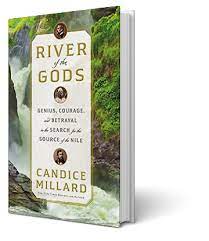
This book tells the astonishing story of the two British expeditions sponsored and funded by the Royal Geographic Society in London to find the source of the Nile River, the longest river in the world, a mystery that had confounded explorers back to Roman times.
First, a word of explanation. Approximately 1,500 miles up-river from its terminus on the Mediterranean Sea, the Nile splits into two branches at Khartoum in present day Sudan. The left branch, called the Blue Nile, is approximately 900 miles long and flows out of Lake Tana in what is now Ethiopia. The source of the Blue Nile was discovered in the 16th Century by a Portuguese explorer. But, despite numerous attempts over the centuries, the source of the White Nile, the longer of the two branches, remained unknown. By the mid-19thCentury it had become the Holy Grail of exploration.
The two Englishmen at the center of this story of exploration are Richard Burton and John Speke. Burton came from a military family and studied at Oxford before dropping out to join the British Army. He was a uniquely talented linguist who was fluent in twenty-nine languages. A true eccentric, Burton once disguised himself as an Arab Muslim to gain admission to the holy city of Mecca, for which he could have been put to death had he been discovered.
Speke was the scion of an English aristocratic family, whose main interest in life was big game hunting in foreign lands. But he had surveying skills that were important to the expeditions on which he was to embark.
The first expedition from 1856 to 1859 was led by Burton with Speke as his assistant. Rather than simply proceed up-river from Khartoum as other explorers had done, this expedition would proceed overland from the east coast of Africa, intending to intercept the headwaters of the White Nile.
This expedition took almost three years, finally reaching Lake Tanganyika in the African Lake District. It staggers the imagination to grasp the difficulties – disease, hunger, attacks from hostile African tribes, desertions, etc. – that Burton and Speke endured, reconstructed by the author based on journals, eyewitness accounts and public reports. At one point Speke was so sick it took three men to support him. Burton suffered so severely from ague that he was confined to his tent for a month. Speke was almost totally blind at one point.
But they were not successful in finding what they came for, and dwindling provisions forced them to backtrack and return to the coast.
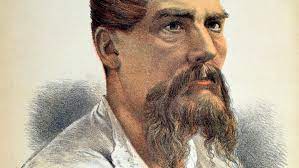
The author describes the rivalry and betrayal (by Speke) that eventually overtook the two men. In the case of Speke, it was raw ambition run amok. But it was that ambition (and incidentally aristocratic connections at the Royal Geographic Society) that resulted in Speke being appointed, to the exclusion of Burton (pictured above), to lead the second expedition to East Africa that occurred from 1860 to 1863.
I won’t say more for fear of spoiling what is a gripping story with a dramatic ending, beyond observing that the two Nile expeditions strike this reviewer as being the British equivalent of our Lewis and Clark expedition with which there are interesting parallels.
Candice Millard writes beautiful English and this fast-paced book pulls the curtain back on the exploration of what I remember from grade school as Darkest Africa. A picture album greatly enhances the enjoyment of the book.
Highly recommended – 5 stars.
John A. West (follow on johnawest.net or contact at johnawest2020@gmail.com).
 Westwind